
news
2026-04-27
Advancing the International Communication of Chinese Culture to Deeper Levels
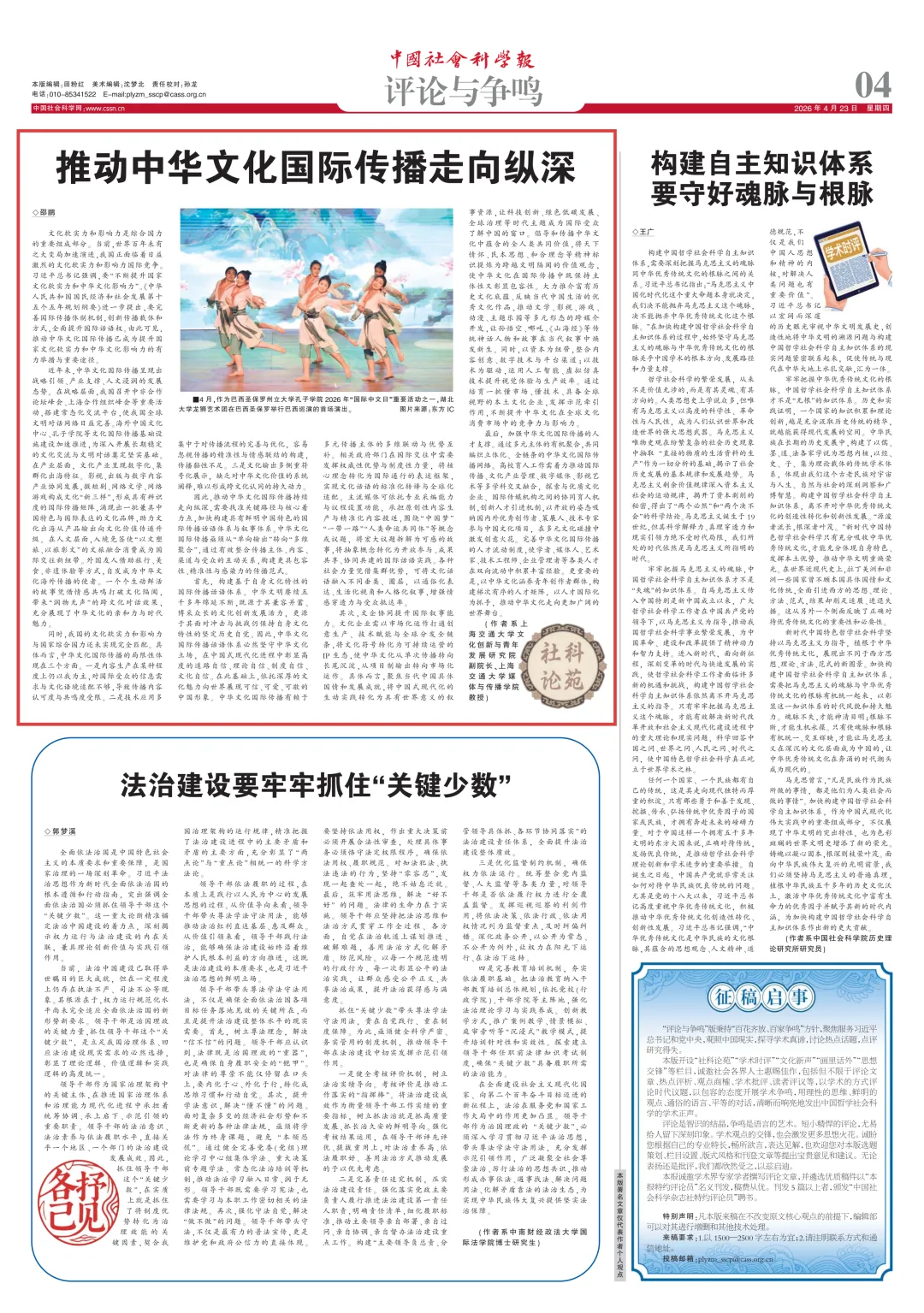
文化软实力和影响力是综合国力的重要组成部分。当前,世界百年未有之大变局加速演进,我国正面临着日益激烈的文化软实力和影响力国际竞争。习近平总书记强调,要“不断提升国家文化软实力和中华文化影响力”。《中华人民共和国国民经济和社会发展第十五个五年规划纲要》进一步提出,要完善国际传播体制机制,创新传播载体和方式,全面提升国际话语权。由此可见,推动中华文化国际传播已成为提升国家文化软实力和中华文化影响力的有力举措与重要途径。
Cultural soft power and influence constitute an important part of a country’s comprehensive national strength. At present, the profound changes unseen in the world in a century are accelerating, and China is facing increasingly fierce international competition in cultural soft power and influence. General Secretary Xi Jinping has emphasized the need to "constantly enhance the country’s cultural soft power and the influence of Chinese culture." The Outline of the 15th Five-Year Plan for National Economic and Social Development of the People’s Republic of China further proposes to improve the systems and mechanisms for international communication, innovate communication carriers and methods, and fully amplify China’s international discourse power. It is thus evident that advancing the international communication of Chinese culture has become a powerful measure and an important pathway for enhancing the country’s cultural soft power and the influence of Chinese culture.
近年来,中华文化国际传播呈现出战略引领、产业支撑、人文浸润的发展态势。在战略层面,我国召开中非合作论坛峰会、上海合作组织峰会等重要活动,搭建常态化交流平台,使我国全球文明对话网络日益完善。海外中国文化中心、孔子学院等文化国际传播基础设施建设加速推进,为深入开展长期稳定的文化交流与文明对话奠定坚实基础。在产业层面,文化产业呈现数字化、集群化出海特征。影视、出版与数字内容产业协同发展,微短剧、网络文学、网络游戏构成文化“新三样”,形成具有辨识度的国际传播矩阵,涌现出一批兼具中国特色与国际表达的文化品牌,助力文化出海从产品输出向文化价值传递升级。在人文层面,入境免签使“以文塑旅、以旅彰文”的文旅融合消费成为国际交往新纽带。外国友人借助旅行、美食、非遗体验等方式,自发成为中华文化海外传播的使者。一个个生动鲜活的故事凭借情感共鸣打破文化隔阂,带来“润物无声”的跨文化对话效果,充分展现了中华文化的亲和力与时代魅力。
In recent years, the international communication of Chinese culture has exhibited a development trend characterized by strategic guidance, industrial support, and humanistic infiltration. At the strategic level, China has hosted major events such as the FOCAC Summit and the SCO Summit, establishing regular exchange platforms and increasingly improving its global network for civilizational dialogue. The development of infrastructure for international cultural communication, including overseas Chinese cultural centers and Confucius Institutes, has accelerated, laying a solid foundation for in-depth, long-term, and stable cultural exchanges and civilizational dialogue. At the industrial level, cultural industries are "going global" with digital and cluster-based features. The film, television, publishing, and digital content industries develop in coordination, with micro-dramas, online literature, and online games forming the "new three items" of Chinese culture. A recognizable international communication matrix has taken shape, giving rise to a number of cultural brands that embody both Chinese characteristics and international expression. These efforts help cultural exports upgrade from product output to the delivery of cultural values. At the humanistic level, visa exemptions for inbound travelers have turned cultural-tourism integration consumption—where culture shapes tourism and tourism highlights culture—into a new bond for international exchanges. Foreign friends, through travel, cuisine, and intangible cultural heritage experiences, spontaneously become envoys for the overseas communication of Chinese culture. Vivid stories bridge cultural gaps through emotional resonance, achieving cross-cultural dialogue effects that "moisten things silently," fully demonstrating the affinity and contemporary charm of Chinese culture.
同时,我国的文化软实力和影响力与国家综合国力还未实现完全匹配。具体而言,中华文化国际传播的局限性体现在三个方面。一是内容生产在某种程度上仍以我为主,对国际受众的信息需求与文化语境适配不够,导致传播内容认可度与共鸣度受限。二是技术应用多集中于对传播流程的完善与优化,容易忽视传播的精准性与情感联结的构建,传播黏性不足。三是文化输出多侧重符号化展示,缺乏对中华文化价值的系统阐释,难以形成跨文化认同的持久动力。
Nevertheless, China’s cultural soft power and influence still do not fully match its comprehensive national strength. Specifically, the limitations in the international communication of Chinese culture are reflected in three aspects. First, content production remains somewhat China-centric, with insufficient adaptation to the information needs and cultural contexts of international audiences, limiting the recognition and resonance of communicated content. Second, technological applications mostly focus on refining and optimizing communication processes, often neglecting the precision of communication and the building of emotional connections, resulting in insufficient audience engagement. Third, cultural exports tend to emphasize symbolic displays, lacking systematic interpretation of the values of Chinese culture, making it difficult to sustain cross-cultural identity.
因此,推动中华文化国际传播持续走向纵深,需要找准关键路径与核心着力点,加快构建具有鲜明中国特色的国际传播话语体系与叙事体系。中华文化国际传播亟须从“单向输出”转向“多维聚合”,通过有效整合传播主体、内容、渠道与受众的互动关系,构建更具包容性、精准性与感染力的传播范式。
Therefore, to continuously advance the international communication of Chinese culture to deeper levels, it is necessary to identify key pathways and core priorities, and accelerate the development of international communication discourse and narrative systems with distinct Chinese characteristics. The international communication of Chinese culture urgently needs to shift from "one-way output" to "multi-dimensional aggregation", constructing a more inclusive, precise, and engaging communication paradigm by effectively integrating the interactive relationships between communicators, content, channels, and audiences.
首先,构建基于自身文化特性的国际传播话语体系。中华文明赓续五千多年绵延不断,既源于其兼容并蓄、博采众长的文化创新发展活力,更源于其面对冲击与挑战仍保持自身文化特性的坚定历史自觉。因此,中华文化国际传播话语体系必然坚守中华文化立场,在中国式现代化进程中彰显高度的道路自信、理论自信、制度自信、文化自信。在此基础上,依托深厚的文化魅力向世界展现可信、可爱、可敬的中国形象。中华文化国际传播有赖于多元传播主体的多维联动与优势互补。相关政府部门在国际交往中需要发挥权威性优势与制度性力量,将核心理念转化为国际通行的表述框架,实现文化话语的标准化转译与全球化适配。主流媒体可依托专业采编能力与议程设置功能,承担原创性内容生产与精准化内容投送,围绕“中国梦”“一带一路”“人类命运共同体”等概念或议题,将宏大议题拆解为可感的故事,将抽象概念转化为开放参与、成果共享、协同共建的国际话语实践。各种社会力量凭借集群优势,可将文化话语融入不同垂类、圈层,以通俗化表达、生活化视角和人格化叙事,增强情感穿透力与受众抵达率。
First, develop an international communication discourse system rooted in its own cultural characteristics. The uninterrupted continuation of Chinese civilization for over 5,000 years stems not only from its dynamic cultural innovation and development marked by inclusiveness and learning from others but also from its firm historical consciousness in maintaining its own cultural identity amid shocks and challenges. Thus, the international communication discourse system of Chinese culture must firmly uphold the stance of Chinese culture, demonstrating strong confidence in its path, theory, system, and culture in the course of Chinese-style modernization. On this basis, China presents a credible, lovable, and respectable image to the world through its profound cultural allure. The international communication of Chinese culture relies on multi-dimensional collaboration and complementary strengths of diverse communicators. Relevant government departments need to leverage their authoritative advantages and institutional power in international exchanges, translating core concepts into internationally recognized frameworks for expression, and achieving standardized translation and global adaptation of cultural discourse. Mainstream media, drawing on their professional editing capabilities and agenda-setting functions, undertake original content production and targeted content delivery. Centered on concepts and issues such as the "Chinese Dream," the "Belt and Road Initiative," and the "Community with a Shared Future for Mankind," they break down grand narratives into tangible stories and transform abstract concepts into international discourse practices featuring open participation, shared achievements, and collaborative development. Various social forces, leveraging their collective strengths, can integrate cultural discourse into different vertical sectors and circles, enhancing emotional penetration and audience reach through popular expression, daily-life perspectives, and personalized narratives.
其次,文企协同提升国际叙事能力。文化企业需以市场化运作打通创意生产、技术赋能与全球分发全链条,将文化符号转化为可持续运营的IP生态,使中华文化从单次传播转向长尾沉淀,从项目制输出转向市场化运作。具体而言,聚焦当代中国具体国情和发展成就,将中国式现代化的生动实践转化为具有世界意义的叙事资源,让科技创新、绿色低碳发展、全球治理等时代主题成为国际受众了解中国的窗口。倡导和传播中华文化中蕴含的全人类共同价值,将天下情怀、民本思想、和合理念等精神标识提炼为跨越文明隔阂的价值观念,使中华文化在国际传播中既保持主体性又彰显包容性。大力推介富有历史文化底蕴、反映当代中国生活的优秀文化作品,推动文学、影视、游戏、动漫、主题乐园等多元形态的跨媒介开发,让孙悟空、哪吒、《山海经》等传统神话人物和故事在当代叙事中焕发新生。同时,以资本为纽带,整合内容创意、数字技术与平台渠道;以技术为驱动,运用人工智能、虚拟仿真技术提升视觉体验与生产效率。通过培育一批懂市场、懂技术、具备全球视野的本土文化企业,发挥示范牵引作用,不断提升中华文化在全球文化消费市场中的竞争力与影响力。
Second, enhance international narrative capabilities through collaboration between cultural institutions and enterprises. Cultural enterprises need to adopt market-oriented operations to integrate the entire chain of creative production, technological empowerment, and global distribution, transforming cultural symbols into sustainably operated IP ecosystems. This shifts Chinese culture from one-off communication to long-term accumulation, and from project-based output to market-oriented operations. Specifically, focusing on China’s contemporary national conditions and development achievements, the vibrant practices of Chinese-style modernization are translated into globally significant narrative resources, making themes of our times such as scientific and technological innovation, green and low-carbon development, and global governance windows for international audiences to understand China. We advocate and promote the common values of humanity embodied in Chinese culture, refining spiritual symbols such as a global vision, people-centered philosophy, and the concept of harmony into values that bridge civilizational divides, enabling Chinese culture to maintain its subjectivity while demonstrating inclusiveness in international communication. We vigorously promote outstanding cultural works with profound historical and cultural heritage that reflect contemporary Chinese life, and advance cross-media development of diverse forms such as literature, film and television, games, animation, and theme parks, allowing traditional mythological figures and stories such as the Monkey King, Nezha, and The Classic of Mountains and Seas to thrive in contemporary narratives. Meanwhile, with capital as a link, we integrate content creativity, digital technology, and platform channels; driven by technology, we apply artificial intelligence and virtual simulation technologies to enhance visual experiences and production efficiency. By nurturing a group of local cultural enterprises that understand the market, master technology, and possess a global vision, we set exemplary benchmarks and continuously enhance the competitiveness and influence of Chinese culture in the global cultural consumption market.
最后,加强中华文化国际传播的人才支撑。通过多元主体的有机聚合,共同编织立体化、全链条的中华文化国际传播网络。高校育人工作需着力推动国际传播、文化产业管理、数字媒体、影视艺术等多学科交叉融合,探索与优质文化企业、国际传媒机构之间的协同育人机制,创新人才引进机制,以开放的姿态吸纳国内外优秀创作者、策展人、技术专家参与中国文化项目,在多元文化碰撞中激发创意火花。完善中华文化国际传播的人才流动制度,使学者、媒体人、艺术家、技术工程师、企业管理者等各类人才在双向流动中积累丰富经验。更重要的是,以中华文化涵养青年创作者群体,构建梯次有序的人才矩阵,以人才国际化为抓手,推动中华文化走向更加广阔的世界舞台。
Finally, strengthen talent support for the international communication of Chinese culture. Through the organic integration of diverse stakeholders, we jointly build a multi-layered, full-chain international communication network for Chinese culture. Universities should focus on promoting interdisciplinary integration in fields such as international communication, cultural industry management, digital media, and film and television art. They should explore collaborative talent training mechanisms with high-quality cultural enterprises and international media organizations, and innovate talent introduction mechanisms, adopting an open attitude to attract outstanding domestic and foreign creators, curators, and technical experts to participate in Chinese cultural projects, sparking creative ideas amid cultural diversity. We improve talent mobility systems for the international communication of Chinese culture, enabling scholars, journalists, artists, technical engineers, and enterprise managers to gain rich experience through two-way mobility. More importantly, we nurture young creators with Chinese culture, build a well-structured talent pool, and leverage talent internationalization to propel Chinese culture onto an even broader global stage.
作者:邵鹏,系上海交通大学文化创新与青年发展研究院副院长、上海交通大学媒体与传播学院教授
The author is Shao Peng, Vice Dean of the Institute for Cultural Innovation and Youth Development, Shanghai Jiao Tong University, and Professor at the School of Media and Communication, Shanghai Jiao Tong University.
来源:中国社会科学报
Source: Chinese Social Sciences Today
联系我们
地 址:北京市东城区东四南大街249号
邮 箱:mishuchu@capiece.cn
电 话:65121825、18500990410
联系人:秘书处 牛先生
网 址:www.capiece.cn